I receive a constant barrage of offers from third-party photo-editing services. They find my Google Business profile and phone me. They find my website and use the contact form to send me emails. My LinkedIn feed is full of their advertising.
I’ve listened to their sales pitches and read their marketing materials. It all sounds pretty cool. “Grow your business faster! You’re a talented photographer. You should be out there shooting for your next client, not stuck in front of a computer editing a backlog of previous jobs. Do what you do best, and let us take care of the boring stuff.”
What I never have done, and never will do, is actually use any of these third-party services. They say they will expertly cull my wedding photographs. They say they can uniformly colour-correct my pictures of corporate events. Background cleanup, skin smoothing, portrait enhancement – they’ll do it all. I believe they use a combination of AI tools and human Photoshop experts. It’s possible that the results are technically correct. But I don’t want my work handled by a data centre in Kansas, or a graphic designer in Slovenia, however good they are.
From darkroom to Lightroom
For me, selecting the best images that I captured during a shoot, and then using the relatively simple tools available in Lightroom and (very occasionally) Photoshop to make them as strong as they can be, is as much part of the job as it was when I did the same kind of work manually, in the darkroom.
Am I just a Luddite, stubbornly refusing to accept technological progress? I don’t think so. I gladly embraced digital photography, and have no nostalgia for the darkroom. I love my mirrorless cameras, and wouldn’t go back to SLRs. I still control exposure entirely manually, because that gives me the best results. But I’m happy to use autofocus and auto white balance most of the time. Adobe’s photo-editing software is not perfect, but nor was my darkroom equipment and technique.
So, no, I am no technophobe. But I insist – as a photographer, selecting and editing my own photographs is part of my job. Here are three reasons why.
I was there
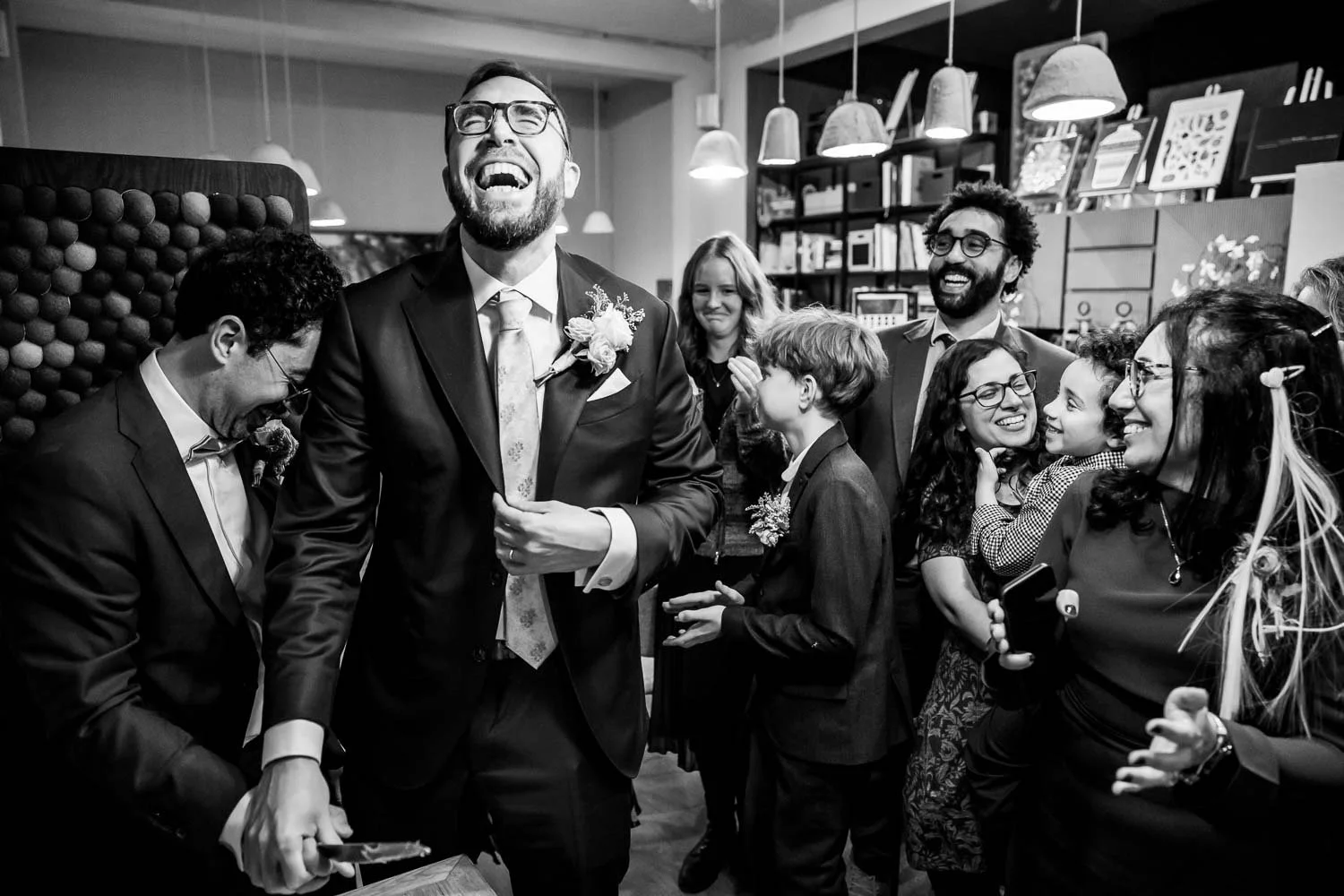
First, I was in the room. There was no AI agent present at the shoot. I didn’t see the Slovenian Photoshop expert there, either. I was there with my client, with my client’s guests or participants. I watched them. I talked to them. I heard how they talked to one another. I know why they were laughing or crying at the moment I released the shutter. I know what the mood in the room was. I know what feeling my client would like the photos to convey. I know what they are proud of, and I know (or can guess) what they are less proud of. So don’t tell me that I should delegate the work of selecting the ‘keepers’. How could an agent – whether human or machine – possibly make such a well-informed choice as me?
I want my images to stand out
Second, I don’t want my photos to look like everyone else’s. The way I recrop, retouch and colour balance each image is personal. I tend to think of myself as an artisan rather than an artist, but these are still aesthetic choices. I am proud of my style, and I believe that clients choose me not because my images look like what they are used to seeing on Instagram, but because they don’t look like what they are used to seeing on Instagram. (I am not on Instagram.) I’m talking about freshness, emotion, spontaneity, authenticity.
I want to be a better photographer
Third, I want to continue to improve as a photographer. Every job teaches me something new. I shoot. I try different things. Sometimes I screw up. Sometimes, a happy accident produces an unexpectedly magical image. Above all, becoming a better photographer means getting more images closer to perfection in the camera, and therefore reducing the time needed for editing. But if I wasn’t doing the post-production work myself, I would never see the mistakes or the magic, and would never have the chance to learn from them. Outsourcing post-production to a third-party service would break the feedback loop.


